
Corporation Tax Deadlines 2026: A UK Company Guide
Every UK Corporation Tax deadline for 2026 - when to register, when to pay (9 months + 1 day), when to file your CT600 (12 months), and what HMRC charges if you're late.
Invoclouds
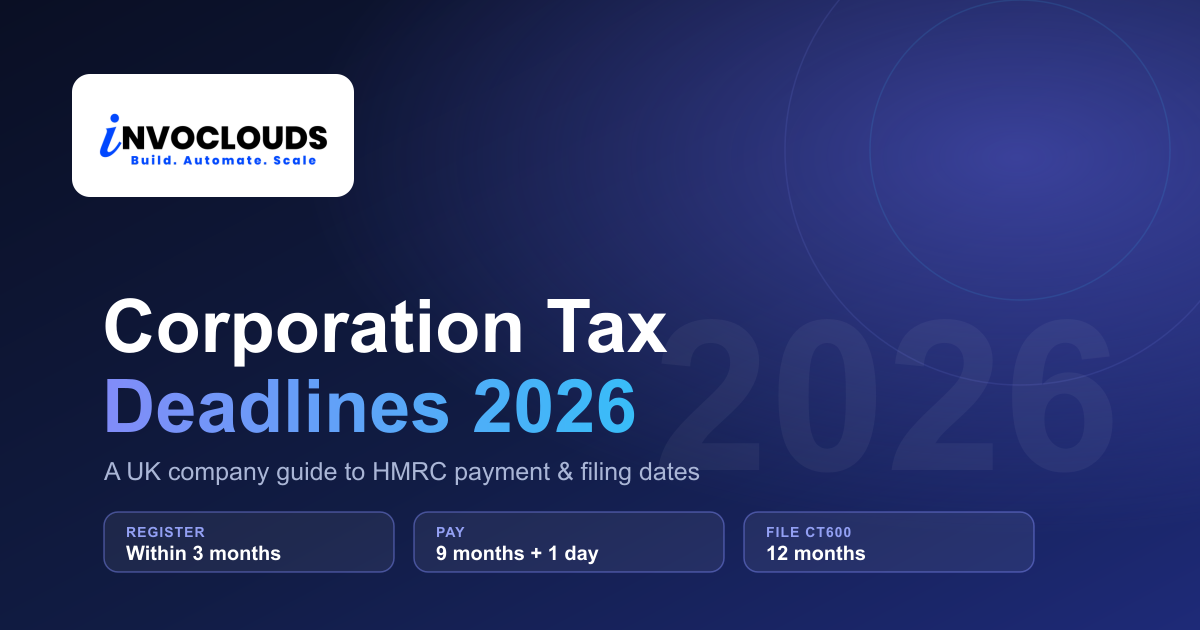
Missing a Corporation Tax deadline in the UK is one of the most expensive mistakes a limited company can make - and one of the easiest to avoid. This guide breaks down every Corporation Tax deadline for 2026: when to register, when to pay, when to file your CT600 Company Tax Return, and exactly what HMRC charges when you're late. Whether you run a startup, contract through your own limited company, or handle filings for clients, you'll finish knowing precisely what's due and when.
Key Takeaways
- You must pay Corporation Tax 9 months and 1 day after the end of your accounting period (for taxable profits up to £1.5 million).
- You must file your Company Tax Return (CT600) within 12 months of the end of your accounting period - so the payment deadline actually falls before the filing deadline.
- New companies must register for Corporation Tax within 3 months of starting to trade.
- Late filing penalties start at £100 and escalate to tax-geared penalties of up to 20% of the unpaid tax.
- The main Corporation Tax rate is 25%, with a 19% small profits rate for profits up to £50,000.
What counts as a Corporation Tax deadline?
Every UK limited company pays Corporation Tax on its profits, and every Corporation Tax deadline is tied to your company's accounting period - not to a fixed date in the calendar like Self Assessment.
Your accounting period usually matches the financial year covered by your annual accounts (12 months). So two companies can have completely different Corporation Tax due dates depending on when their financial year ends. If your year end is 31 March, your deadlines differ from a company with a 31 December year end.
That single fact - deadlines are relative to your year end - is why so many directors miss them. Below, we translate the rules into exact dates you can diarise.
Corporation Tax deadlines 2026 at a glance
Here's how the three core deadlines line up for a company with a 31 March 2026 accounting period end, as a worked example:
| Obligation | Deadline rule | Example (year end 31 Mar 2026) |
|---|---|---|
| Register for Corporation Tax | Within 3 months of starting to trade | Within 3 months of trading |
| Pay your Corporation Tax bill | 9 months + 1 day after period end | 1 January 2027 |
| File your Company Tax Return | 12 months after period end | 31 March 2027 |
Swap in your own year end and the same rules apply. Now let's take each deadline in turn.
The Corporation Tax payment deadline: 9 months and 1 day
For most small and medium companies (those with taxable profits up to £1.5 million), the Corporation Tax payment deadline is 9 months and 1 day after the end of your accounting period, according to GOV.UK.
So if your accounting period ends on 31 March 2026, your Corporation Tax bill is due by 1 January 2027. If it ends 31 December 2026, payment is due by 1 October 2027.
- Allow time for the payment to clear. HMRC treats the payment as made on the date the money reaches them, so leave several working days for bank transfers, Direct Debit, or online card payments.
- You pay before you file. This catches out almost every first-time director - see below.
- No bill? Tell HMRC. If you have nothing to pay (for example, a dormant company or a loss-making year), you must still let HMRC know by the deadline that no payment is due.
Why the payment deadline comes before the filing deadline
It sounds backwards, but the Corporation Tax payment deadline (9 months and 1 day) arrives roughly three months before the Company Tax Return deadline (12 months).
In practice, that means you need to work out your Corporation Tax well before your CT600 is legally due, so you know how much to pay on time. Most well-run companies simply prepare their accounts and return together, then pay and file in one go - comfortably ahead of both deadlines.
The Company Tax Return (CT600) deadline: 12 months
Your Company Tax Return deadline - the CT600 deadline - is 12 months after the end of the accounting period it covers, per GOV.UK.
A CT600 isn't just one form. When you file, you typically submit:
- The CT600 return itself, showing your taxable profit and the Corporation Tax due.
- Your statutory accounts (the company accounts for the period).
- Your tax computations, showing how you got from profit in the accounts to taxable profit.
Accounts and computations are usually filed in iXBRL format, which is why most companies use tax return software or an accountant rather than filing on paper. You file online through your HMRC online account using your Government Gateway login and your company's UTR (Unique Taxpayer Reference).
Do you still file if you made a loss? Yes. Even if your taxable profits are zero or you made a loss, if HMRC has asked you to deliver a return, you must file your Company Tax Return by the deadline. Filing a loss can also be valuable - it may reduce future or past Corporation Tax bills.
The Corporation Tax registration deadline: 3 months
Newly formed companies have an easy-to-miss first deadline. You must register for Corporation Tax within 3 months of starting to do business ("becoming active") - this includes trading, buying, selling, advertising, or earning any income.
When you register for Corporation Tax, HMRC sets your accounting period and issues (or confirms) your UTR. Get this wrong and your very first Corporation Tax deadline can pass before you realise the clock started.
Tip for new companies: register for Corporation Tax as soon as you start trading, not three months later. It removes the risk entirely and unlocks your online filing account sooner.
First-year companies: why you might file two returns
Your first accounting period can cause confusion. A company's first accounts often cover slightly more than 12 months (Companies House sets the first accounting reference date to the anniversary month-end of incorporation).
Because a Corporation Tax accounting period can't exceed 12 months, HMRC may split that first stretch into two returns: one 12-month period and one short period covering the remaining days. Each has its own payment deadline (9 months and 1 day) and its own CT600 deadline (12 months). It's a common trap for new companies - if in doubt, check the exact periods shown in your HMRC online account.
Corporation Tax instalment payments (larger companies)
The 9-months-and-1-day rule only applies to companies with taxable profits up to £1.5 million. Larger companies pay earlier, in instalments:
- Profits over £1.5 million: Corporation Tax is paid in quarterly instalment payments, starting during the accounting period rather than after it.
- "Very large" companies (profits over £20 million): instalments are brought forward even further.
These thresholds are reduced if you have associated companies. If your profits are anywhere near £1.5 million, check the detailed instalment payments rules on GOV.UK before your first quarter - the deadlines are much earlier than most directors expect.
What happens if you miss a Corporation Tax deadline?
HMRC applies separate consequences for filing late and paying late. You can be hit by both at once, so it's worth understanding each.
Late filing penalties
Miss the CT600 deadline and the penalties for a late Corporation Tax return stack up as follows (source: GOV.UK):
| Time after your filing deadline | Penalty |
|---|---|
| 1 day late | £100 |
| 3 months late | Another £100 (£200 in total) |
| 6 months late | HMRC estimates your bill + a 10% penalty on the unpaid tax |
| 12 months late | A further 10% of any unpaid tax |
If your Company Tax Return is late three times in a row, the £100 penalties increase to £500 each. Combined, the two tax-geared penalties can reach 20% of the unpaid Corporation Tax - on top of the flat-rate fines.
Late payment interest
Miss the Corporation Tax payment deadline and HMRC charges interest on the overdue amount from the day after the payment was due until you pay in full. Interest is charged at HMRC's published late-payment rate, which changes over time - so an overdue bill quietly grows every day it stays unpaid.
Corporation Tax rates for 2026
Knowing the Corporation Tax rate matters because it determines how much you must have ready by the payment deadline. As of 2026 (rates in force since 1 April 2023, per GOV.UK):
- Main rate - 25%: applies to companies with taxable profits over £250,000.
- Small profits rate - 19%: applies to profits of £50,000 or less.
- Marginal Relief: companies with profits between £50,000 and £250,000 pay an effective rate between 19% and 25%.
The £50,000 and £250,000 thresholds are reduced for short accounting periods and split between associated companies. Estimating your Corporation Tax at your year end - not when the return is due - is the single best way to avoid a nasty surprise at the payment deadline.
How to never miss a Corporation Tax deadline
A few habits keep you permanently compliant:
- Diarise from your year end. The moment your accounting period closes, add two reminders: payment (9 months + 1 day) and filing (12 months).
- Reconcile monthly, not annually. Keeping bookkeeping current means your taxable profits - and therefore your bill - are never a mystery.
- Prepare accounts and CT600 together. File once, ahead of the payment date, so you know exactly what to pay.
- Use software that tracks HMRC deadlines for you. This is where a filing platform earns its keep.
Invoclouds is built for exactly this. Our cloud software tracks your Corporation Tax deadlines, prepares your CT600 and company accounts, and submits directly to HMRC and Companies House - so a missed deadline stops being something you have to remember. You can file your Corporation Tax return with Invoclouds and see every due date in one dashboard.
Don't confuse these with your Companies House deadlines
Corporation Tax deadlines go to HMRC. Separately, you have Companies House obligations that run on their own clock:
- Annual accounts - filed with Companies House (a different deadline from your CT600, even though the accounts overlap).
- Confirmation statement - an annual snapshot of your company details.
Mixing these up is one of the most common compliance errors for small companies. Read our guide to Confirmation Statement deadlines and Corporation Tax explained to keep every filing straight.
Frequently Asked Questions
When is Corporation Tax due in the UK?
For companies with taxable profits up to £1.5 million, Corporation Tax is due 9 months and 1 day after the end of your accounting period. For example, a company with a 31 March 2026 year end must pay by 1 January 2027.
What is the CT600 filing deadline?
The CT600 (Company Tax Return) deadline is 12 months after the end of the accounting period it covers. This is later than the payment deadline, so you effectively need your figures ready before the return is even due.
Do I have to file a Company Tax Return if my company made a loss?
Yes. If HMRC has asked you to deliver a return, you must file your CT600 by the deadline even if you made a loss or have no tax to pay. Reporting a loss can also reduce Corporation Tax in other years.
What is the penalty for filing a Corporation Tax return late?
Late filing penalties start at £100 (1 day late), rise by another £100 at 3 months, then add 10% of the unpaid tax at 6 months and a further 10% at 12 months. Three consecutive late returns push the £100 penalties up to £500 each.
When do I need to register for Corporation Tax?
You must register for Corporation Tax within 3 months of starting to do business - trading, advertising, buying, selling, or otherwise becoming active.
What is the Corporation Tax rate for 2026?
The main rate is 25% for profits over £250,000, with a 19% small profits rate for profits up to £50,000 and Marginal Relief in between. These rates have applied since 1 April 2023.
Is the Corporation Tax deadline the same as my Companies House accounts deadline?
No. Your Corporation Tax deadlines go to HMRC, while your annual accounts and confirmation statement go to Companies House on separate deadlines. It's easy to confuse them, which is why many directors use software that tracks all of them together.
Conclusion
The rules behind every Corporation Tax deadline in the UK come down to three numbers tied to your accounting period: register within 3 months, pay after 9 months and 1 day, and file within 12 months. Miss them and the penalties - flat fines plus tax-geared charges of up to 20% and daily interest - add up fast.
The safest way to stay ahead of every HMRC Corporation Tax deadline is to let software do the remembering. Sign up for Invoclouds free to track your deadlines, prepare your CT600, and file with HMRC and Companies House from one place.
This guide is general information, not tax advice. Tax figures, thresholds, and deadlines can change - always confirm current rules on [GOV.UK](https://www.gov.uk/corporation-tax) or with a qualified accountant.